News
Bridging Control Gaps in Tire Manufacturing Using the Type 1000 I/P Transducer
How Precise Valve Control Drives Quality, Consistency, and Efficiency
Tire manufacturing is a process where precision is not optional. It is essential.
From molding and curing to press control and material handling, every stage depends on maintaining tight control over pressure, temperature, and airflow. These variables directly impact tire uniformity, structural integrity, and overall product quality.
At the center of it all is valve control.
Why Valve Control Is Critical to Tire Quality
Modern tire production relies on pneumatic valves to regulate critical process inputs like steam, air, and hydraulic pressure.
These valves must respond quickly and consistently to maintain:
• Stable molding pressures
• Accurate curing temperatures
• Controlled material handling processes
Even small delays or inconsistencies in valve response can create significant issues, including:
• Mold defects
• Material waste
• Uneven curing
• Reduced product uniformity
In high-volume production environments, these problems scale quickly.
The Disconnect Between Electrical Control and Pneumatic Systems
Today’s production lines are driven by advanced PLCs and digital control systems.
These systems operate using electrical signals, allowing for precise command and automation. However, pneumatic actuators still require air pressure to function.
This creates a critical gap.
Without a reliable interface between electrical control signals and pneumatic output:
• Response times can lag
• Pressure control becomes less stable
• Valve movement becomes less repeatable
That gap is where inconsistency begins.
Converting Signals Into Stable Control
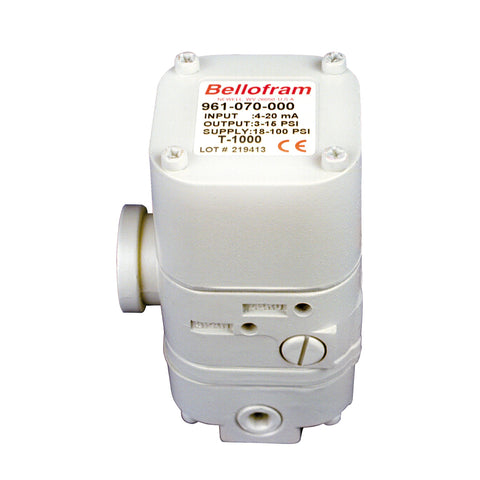
The Type 1000 I to P Transducer is designed to close that gap.
It converts a standard 4–20 mA electrical signal from a PLC into a proportional pneumatic output, allowing electronic control systems to directly manage valve operation.
This enables:
• Smooth, repeatable valve movement
• Precise control of steam, air, and hydraulic pressure
• Improved synchronization between system inputs and outputs
In tire manufacturing, that level of control is critical to maintaining consistency across every stage of production.
Built for Fast Response and Demanding Conditions
Tire production environments are fast-moving and high-pressure, both literally and operationally.
The Type 1000 is engineered to perform under these conditions with:
• An electromagnetic force-balance design that continuously adjusts output pressure to match the input signal
• A built-in volume booster delivering up to 12 SCFM for rapid valve response
• A supply range that supports stable operation under demanding system requirements
This combination ensures valves respond quickly and accurately, helping maintain consistent curing and molding pressures throughout the process.
Improving Efficiency, Reducing Scrap
When valve control is precise, the benefits extend across the entire operation.
• More consistent product quality
• Greater overall process efficiency
• Reduced material waste and scrap
• Shorter and more predictable cycle times
Instead of reacting to inconsistencies, manufacturers can maintain control from the start.
Supporting the Future of Tire Manufacturing
As tire production continues to evolve, manufacturers are pushing for tighter control, greater efficiency, and improved product consistency.
Even as digital systems become more advanced, pneumatic actuation remains a core part of the process.
The need is not to replace pneumatics. It is to control them better.
The Type 1000 I to P Transducer plays a key role in this future by reliably converting electronic control signals into stable pneumatic output. Its proven accuracy, fast response, and durable design make it well-suited for modern automated curing and molding systems.
See How Signal Conversion Improves Valve Control
Want a deeper look at how valve control impacts tire quality, cycle time, and production efficiency?
The full application study walks through the challenges, system requirements, and how the Type 1000 delivers consistent, repeatable control in demanding tire manufacturing environments.
Download the Application Study to see how precise signal conversion improves valve performance and production outcomes.
Common Questions About the Type 1000 I/P Transducer in Tire Manufacturing
Why is valve control important in tire manufacturing?
Valve control is important in tire manufacturing because pneumatic valves help regulate steam, air, and hydraulic pressure throughout molding, curing, press control, and material handling processes. Consistent valve response supports better tire uniformity, process stability, and product quality.
What control gaps can occur in tire production systems?
Control gaps can occur when advanced PLCs and digital control systems send electrical command signals, but pneumatic actuators still require stable air pressure to operate. Without a reliable interface between the electrical signal and pneumatic output, response times can lag and valve movement can become less repeatable.
How does the Type 1000 I/P Transducer support tire manufacturing?
The Type 1000 I/P Transducer supports tire manufacturing by converting a 4–20 mA electrical signal from a PLC into a proportional pneumatic output. This allows electronic control systems to manage pneumatic valve operation with more stable, repeatable, and responsive control.
Why is signal conversion important for pneumatic valve control?
Signal conversion is important because PLCs operate with electrical signals while pneumatic valves and actuators require air pressure. An I/P transducer bridges that gap by translating the electrical command into a matching pneumatic output that can control valve movement.
How can inconsistent valve response affect tire quality?
Inconsistent valve response can affect tire quality by disrupting molding pressure, curing temperature control, air pressure stability, and material handling accuracy. These issues can contribute to mold defects, uneven curing, material waste, reduced uniformity, and longer cycle times.
What makes the Type 1000 suitable for demanding production environments?
The Type 1000 is suited for demanding production environments because it uses an electromagnetic force-balance design that continuously adjusts output pressure to match the input signal. It also includes a built-in volume booster that supports fast valve response in high-demand pneumatic control applications.
How does better valve control help reduce scrap in tire manufacturing?
Better valve control helps reduce scrap by improving consistency across pressure, timing, and response during molding and curing. When valves respond more accurately and repeatably, manufacturers can reduce variation that may lead to defects, rework, or rejected product.
Where can the Type 1000 be used in tire production?
The Type 1000 can be used in tire production applications involving pneumatic valve control, curing presses, molding systems, steam control, air pressure regulation, hydraulic pressure control interfaces, and automated production lines that require stable signal-to-pressure conversion.