
Super Cylinders
Low-Friction Super Cylinders for Sensitive Pneumatic Actuation
Bellofram Precision Controls Super Cylinders are specialized single-acting diaphragm air cylinders designed for applications where smooth movement, low friction, and increased sensitivity are important. Based on Bellofram's standard spring-return cylinder design, Super Cylinders incorporate linear ball bearings and hardened steel rods to further reduce mechanical friction during operation.
Super Cylinders are available exclusively in single-acting, spring-return configurations with Series F stroke variations. Multiple equivalent bore diameters provide options for matching pneumatic force and actuator size to the requirements of industrial and OEM equipment.
With operating pressures up to 145 psig, reinforced diaphragm construction, and the same mounting options available for Bellofram standard cylinders, Super Cylinders provide a flexible solution for applications requiring sensitive, repeatable pneumatic linear motion.
Why Choose Bellofram Super Cylinders?
Minimal Mechanical Friction: Linear ball bearings and hardened steel rods reduce friction beyond that of the standard diaphragm cylinder design, making Super Cylinders well suited for applications where actuator sensitivity is important.
Diaphragm-Based Actuation: A reinforced flexible diaphragm converts pneumatic pressure into linear force without the sliding piston seals found in conventional piston-style cylinders.
Spring-Return Operation: Bellofram Super Cylinders are single acting, using pneumatic pressure to generate motion in one direction and an internal spring to provide the return stroke.
Multiple Cylinder Sizes: Available equivalent bore diameters include 3.4, 3.9, 4.5, 5.5, 6.3, and 6.8 inches, allowing cylinder size and available force to be matched to the application.
Series F Stroke Options: Super Cylinders are offered in Series F stroke configurations with available stroke lengths ranging from approximately 2.1 to 4 inches, depending on cylinder size.
Flexible Mounting: The mounting options offered for Bellofram standard diaphragm cylinders are also available for Super Cylinders, providing flexibility for machine and equipment integration.
Super Cylinder Construction
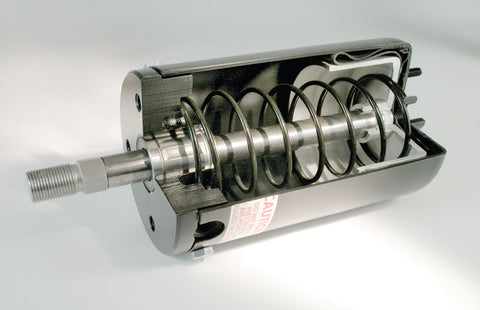
Bellofram Super Cylinders combine a reinforced diaphragm with durable cylinder components designed for industrial pneumatic service. Sizes 4 and 6 use impact-extruded aluminum shells, while larger sizes use steel shells. Ground, polished, hard-chrome-plated steel rods and low-friction bearing components support smooth actuator movement.
The reinforced diaphragm uses a Neoprene elastomer with fabric reinforcement to transfer pneumatic pressure into linear force while maintaining the low-friction characteristics of the diaphragm cylinder design.
Find the Right Super Cylinder
Selecting the right low-friction diaphragm air cylinder depends on required force, available supply pressure, equivalent bore diameter, stroke length, mounting configuration, available installation space, operating temperature, and the sensitivity and movement requirements of the application.
Explore Bellofram Super Cylinders above to compare available sizes and Series F stroke configurations. Bellofram Precision Controls can also assist with selecting a cylinder and mounting arrangement for specialized OEM and industrial pneumatic applications.
Super Cylinder FAQs
What is a Bellofram Super Cylinder?
A Bellofram Super Cylinder is a single-acting, spring-return diaphragm air cylinder equipped with linear ball bearings and hardened steel rods. These components reduce mechanical friction and make the cylinder suitable for pneumatic applications where increased sensitivity is required.
How is a Super Cylinder different from a standard diaphragm air cylinder?
Both use diaphragm-based pneumatic actuation, but Bellofram Super Cylinders add linear ball bearings and hardened steel rods to further minimize mechanical friction. This makes them better suited to applications where particularly sensitive or smooth actuator response is important.
Are Bellofram Super Cylinders single acting or double acting?
Bellofram Super Cylinders are available only as single-acting, spring-return cylinders. Pneumatic pressure produces motion in one direction, and the internal spring returns the actuator when pressure is reduced or removed.
Why do Super Cylinders use linear ball bearings?
Linear ball bearings help reduce friction as the cylinder rod moves. Combined with the diaphragm actuator design and hardened steel rod, this allows the Super Cylinder to provide highly sensitive pneumatic movement.
What sizes are Bellofram Super Cylinders available in?
Bellofram Super Cylinders are available with equivalent bore diameters of 3.4, 3.9, 4.5, 5.5, 6.3, and 6.8 inches. The appropriate size depends on the pneumatic force and dimensional requirements of the application.
What stroke lengths are available for Bellofram Super Cylinders?
Super Cylinders are available in Series F stroke configurations. Available stroke lengths range from approximately 2.1 to 4 inches depending on the selected cylinder size.
What is the maximum operating pressure for a Bellofram Super Cylinder?
Bellofram Super Cylinders are rated for plant-air and operating pressures up to 145 psig, or 10 bar. The complete product specifications should be reviewed when selecting a cylinder for a specific application.
What temperature range can Bellofram Super Cylinders operate in?
Bellofram lists an operating temperature range of approximately -40°F to 225°F (-40°C to 107°C) for its Super Cylinders. Application conditions and material compatibility should be reviewed before use.
Can Super Cylinders use the same mounts as standard Bellofram cylinders?
Yes. Bellofram states that the mounting options available for its standard diaphragm air cylinders are also available for Super Cylinders, providing flexibility when integrating them into machinery and OEM equipment.
How do I choose the right Bellofram Super Cylinder?
Selection should consider required linear force, available pneumatic pressure, equivalent bore diameter, stroke length, mounting configuration, operating temperature, available installation space, and the required sensitivity and movement of the application.
