News
316L vs. 316 Stainless Steel: Choosing the Right Grade for Precision Control
In precision control instrumentation, material selection is the foundation of system uptime, environmental safety, and long-term reliability. For engineers specifying regulators and filters, the decision often centers on two specific austenitic, molybdenum-bearing alloys: 316 and 316L stainless steel.
While both grades offer excellent resistance to chlorides and aggressive media, the distinction between them, driven by carbon content, dictates how a component will perform under high pressure, in sour gas environments, or within highly regulated sanitary systems.
At a Glance: Stainless Steel Selection Matrix
| Feature | 316 Stainless Steel | 316L Stainless Steel |
|---|---|---|
| Carbon Content | Max 0.08% | Max 0.03% ("L" for Low) |
| PCD Product Tier | Type 52 Series (SSAR, SSFR, SSR) | 62SS, 64SS, 66SS, 68SS, 72SS |
| Primary Advantage | Industrial Durability | Chemical & Sanitary Integrity |
| Best For | General Pneumatic Control | Medical / Sour Gas / High-Purity |
The Instrument Grade: Why the "L" Matters for 316L
The "L" in 316L stands for Low Carbon (max 0.03% vs. 0.08% in standard 316). While this difference is small, it provides a critical safeguard against sensitization, a state where chromium and carbon bond at the grain boundaries, leaving the metal vulnerable to localized decay.
Sanitary & Medical Purity (Type 72SS)
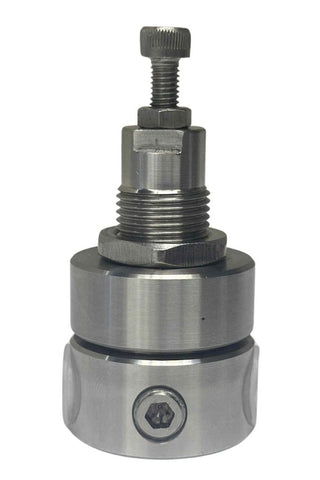
In the pharmaceutical, biotech, and food industries, 316L is the mandatory standard (often required by ASME BPE). The lower carbon content ensures a more stable, non-reactive internal surface that prevents metallic contamination. The Type 72SS 316L Regulator is specifically engineered for these "clean" applications where microbial control and media purity are paramount.
Sour Gas & Chemical Resistance (Type 68SS)
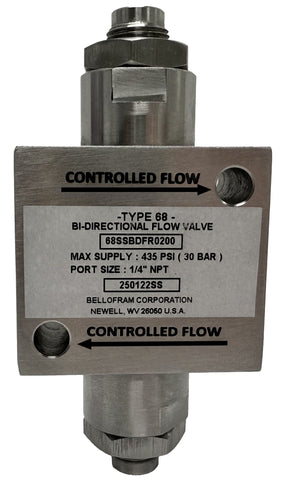
In oil and gas service, 316L is preferred for its superior resistance to Stress Corrosion Cracking (SCC). Its inherent ductility makes it less prone to the hydrogen embrittlement that can cause standard alloys to crack in acidic or "sour" environments. This makes the Type 68SS Bi-Directional Regulator the safer choice for complex chemical flow paths and H₂S exposure.
High-Pressure Integrity (Type 62SS and 66SS)
Even in high-pressure applications, the Type 62SS Regulator and Type 66SS Filter/Regulator utilize 316L bar stock. This ensures that while the unit handles extreme internal loads, the housing remains chemically stable and resistant to the pitting that can occur in harsh offshore or coastal environments.
Precision Machining and Internal Finishes (Type 64SS)
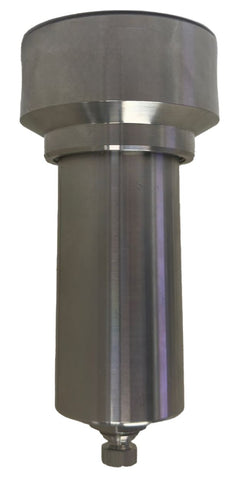
Internal surface roughness (𝑅𝑎) is critical to prevent process media from becoming trapped in microscopic "pockets." By using high-quality bar stock for the Type 64SS Particulate Filter, the 316L housing can be machined to exacting tolerances. This produces a mirror-like internal finish that supports maximum flow efficiency and filtration accuracy, which is essential for protecting downstream sensitive equipment.
The Industrial Workhorse: Standard 316
While the Type 62, 64, 66, 68, and 72 series utilize 316L for precision instrumentation, standard 316 stainless steel remains a robust choice for heavy-duty industrial pneumatic controls.
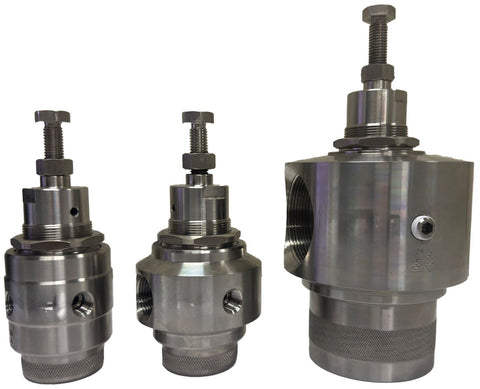
Engineered for extreme stability, the Type 52 Series offers excellent protection against salt spray, humid environments, and corrosive media. Because standard 316 is slightly harder than 316L, the NPT threads on these units are highly resistant to "galling" or deformation during repeated maintenance cycles. Furthermore, the entire series complies with NACE MR0175 for sulfide stress cracking, making it a proven performer in sour gas and offshore oil applications.
To meet specific plant requirements, the series is available in three distinct configurations:
Type 52 SSR (Standard Stainless Steel Regulator)
The Type 52 SSR is the foundational pressure regulator in the series, designed solely for accurate pressure control without built-in filtration.
• Compact Reliability: It features a small footprint (just 6.8" tall) ideal for tight control panels or manifolds. With Nitrile elastomers and a 316 stainless steel housing, it provides reliable, low-droop pressure reduction for standard plant air or corrosive gases where upstream filtration is already present.
Type 52 SSFR (Stainless Steel Filter Regulator)
For applications that require both pressure control and media cleanup at the point of use, the Type 52 SSFR acts as a dual-purpose safeguard.
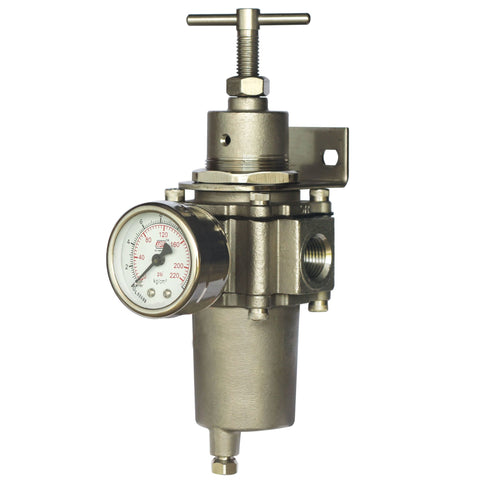
• Complete Protection: This unit integrates a built-in dripwell and a 25-micron sintered 316 stainless steel filter to trap water, oil, and pipeline scale before it reaches sensitive downstream equipment. The manual drain valve allows maintenance teams to quickly flush out accumulated contaminants during routine walk-throughs.
Type 52 SSAR (Filter Regulator with Auto-Drain)
When instrumentation is installed in hard-to-reach locations or remote offshore platforms, manual maintenance isn't always practical. The Type 52 SSAR provides the exact high-performance filtration regulation as the SSFR, but with an automated maintenance cycle.
• Zero-Touch Maintenance: The integrated automatic drain valve senses when the dripwell has reached its liquid capacity and flushes itself. This "set it and forget it" functionality is critical for protecting unattended pneumatic loops from waterlogging, significantly reducing unplanned downtime.
How to Choose: A Practical Summary
• Regulated or Sanitary Environment?: Specify the Type 72SS (316L) for full compliance with medical and food-grade purity standards.
• High-Pressure Gas Handling with Chemical Stability?: The Type 62SS (316L) provides the yield strength required for heavy loads without sacrificing the benefits of low-carbon alloy stability.
• Standard Industrial / Coastal Air?: The Type 52 Series (316) offers the ruggedness needed for general pneumatic filtration and regulation at an industrial value.
• Sour Gas (H2S) Service?: The Type 68SS (316L) is engineered for the ductility required to resist stress cracking in aggressive chemical environments.
Contact our team for an application review to ensure your material choice aligns with your specific pressure, purity, and environmental requirements.
Common Questions About 316L vs. 316 Stainless Steel for Precision Control
What is the main difference between 316L and 316 stainless steel?
The main difference is carbon content. 316L stainless steel has a lower maximum carbon content than standard 316 stainless steel. The “L” stands for low carbon, which helps improve resistance to sensitization and supports better performance in welded, sanitary, chemical, and high-purity applications.
Why does lower carbon content matter in 316L stainless steel?
Lower carbon content helps reduce the risk of chromium carbide formation at grain boundaries. This helps preserve corrosion resistance, especially in applications involving welding, aggressive media, high-purity systems, or environments where long-term material stability is critical.
Is 316L stainless steel better than 316 stainless steel?
316L is often the better choice for sanitary, medical, pharmaceutical, food and beverage, sour gas, high-purity, and highly corrosive applications. Standard 316 stainless steel remains a strong option for rugged industrial pneumatic control where durability, corrosion resistance, and thread strength are important.
When should I specify 316L stainless steel for a regulator or filter?
Specify 316L stainless steel when the application involves sanitary requirements, medical or pharmaceutical media, food and beverage processing, high-purity gases, sour gas exposure, chemical compatibility concerns, or harsh environments where corrosion resistance and material stability are priorities.
Why is 316L commonly used in sanitary and medical applications?
316L is commonly used in sanitary and medical applications because its low-carbon composition supports a more stable, corrosion-resistant surface. This helps reduce contamination concerns and supports cleaner performance in applications where media purity and cleanability are important.
How does 316L stainless steel help in sour gas or chemical applications?
In sour gas and chemical applications, 316L stainless steel can help improve resistance to localized corrosion, stress corrosion cracking, and material degradation. This makes it a strong choice for aggressive media, complex chemical flow paths, and environments where long-term integrity is essential.
Which Bellofram Precision Controls products use 316L stainless steel?
Bellofram Precision Controls products that use 316L stainless steel include the Type 62SS Pressure Regulator, Type 64SS Particulate Filter, Type 66SS Filter/Regulator, Type 68SS Bi-Directional Regulator, and Type 72SS Pressure Reducing Regulator.
Which Bellofram Precision Controls products use standard 316 stainless steel?
The Type 52 stainless steel product series uses standard 316 stainless steel. This includes the Type 52 SSR Stainless Steel Regulator, Type 52 SSFR Stainless Steel Filter Regulator, and Type 52 SSAR Stainless Steel Filter Regulator with Auto-Drain.
How do I choose between 316L and 316 stainless steel for my application?
The right choice depends on the media, pressure range, environment, purity requirements, maintenance expectations, and compliance needs. 316L is typically preferred for sanitary, medical, sour gas, high-pressure, and high-purity applications, while standard 316 can be a practical choice for rugged industrial pneumatic control.