News
Powering Precision in Lithium-Ion Battery Manufacturing with the Type 3700
How Advanced Pressure Control Supports Film Quality, Yield, and Throughput
As lithium-ion battery demand continues to accelerate, manufacturers are under increasing pressure to improve throughput while maintaining strict quality standards.
In battery production, even small inconsistencies can have outsized consequences. Separator films and electrode coatings are extremely thin, and slight variations in tension or pressure can lead to defects that impact performance, safety, and overall yield.
That’s why precision control is no longer optional. It’s foundational.
Why Pressure Control Matters in Battery Film Production
Battery film production is a continuous, high-speed process where multiple variables are constantly changing.
• Line speeds ramp up and down
• Spool diameters shift throughout the run
• Web tension must remain stable across every stage
• Coating uniformity must be preserved end-to-end
Even minor pressure fluctuations can create issues such as:
• Uneven coating thickness
• Wrinkling during winding
• Film stretching or distortion
• Edge misalignment or wander
These are not isolated problems. They compound quickly, leading to scrap, reduced yield, and increased production costs.
The Limitations of Traditional Regulators
Many conventional pressure regulators were not designed for this level of dynamic control.
They typically:
• React too slowly to changing conditions
• Lack integration with modern control systems
• Struggle to maintain stable output under variable demand
The result is a system that is constantly playing catch-up instead of maintaining control.
In battery manufacturing, that gap is where quality issues begin.
A Smarter Approach to Pneumatic Control
To maintain consistent tension and protect product integrity, manufacturers need a solution that can respond in real time.
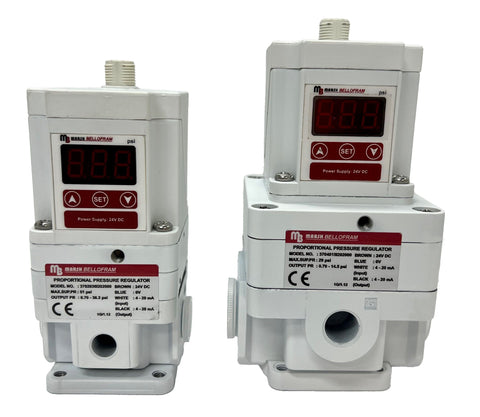
The Type 3700 Proportional Pressure Regulator is designed specifically for these high-performance environments.
By combining electronic control with pneumatic regulation, it delivers:
• Closed-loop control for improved accuracy
• Stable output even during line speed variation
• Seamless integration with PLCs and motion control systems
• Fast, continuous pressure adjustments as conditions change
This allows operators to maintain consistent tension across separator films and electrode coatings, helping ensure uniformity from coating to winding.
Built for Demanding Production Environments
Battery manufacturing environments are not forgiving. Equipment must perform reliably under continuous operation.
The Type 3700 supports this with:
• Reliable performance across long production cycles
• High flow capacity to keep up with dynamic systems
• Rugged, IP65-rated construction for industrial environments
This combination helps reduce variability, improve uptime, and support more consistent output across the entire process.
Supporting the Future of Battery Manufacturing
As production evolves, manufacturers are moving toward smarter, more connected systems.
Automation, data integration, and predictive control are becoming standard expectations.
The Type 3700 is built with this future in mind:
• Electronic architecture enables advanced control strategies
• Integration with plant systems supports data-driven decisions
• Adaptability allows it to scale with faster lines and thinner materials
In short, it’s not just solving today’s challenges. It’s preparing manufacturers for what comes next.
See How Precision Control Impacts Real-World Battery Production
Want a closer look at how pressure regulation directly affects film quality, yield, and performance?
The full application study breaks down the challenges, solution approach, and role of the Type 3700 in lithium-ion battery manufacturing.
Download the Application Study to explore the full details and see how precision control can improve your process.
Where Precision Becomes Performance
In lithium-ion battery production, consistency is everything.
When pressure control is stable, films stay aligned, coatings remain uniform, and production stays on track. When it’s not, small variations quickly turn into larger problems.
The difference often comes down to how quickly and accurately your system can respond.
That’s where advanced proportional control makes a measurable impact.
Common Questions About the Type 3700 in Lithium-Ion Battery Manufacturing
Why is pressure control important in lithium-ion battery manufacturing?
Pressure control is important in lithium-ion battery manufacturing because separator films and electrode coatings are extremely thin and sensitive to variation. Small pressure changes can affect web tension, coating uniformity, alignment, and overall production yield.
How does the Type 3700 support battery film production?
The Type 3700 Proportional Pressure Regulator supports battery film production by providing fast, continuous pressure adjustments as line conditions change. This helps maintain stable tension across separator films and electrode coatings from coating through winding.
What problems can unstable pressure cause in battery film processing?
Unstable pressure can contribute to uneven coating thickness, wrinkling during winding, film stretching, distortion, edge misalignment, and web wander. These issues can increase scrap, reduce yield, and raise production costs.
Why are traditional pressure regulators limited in battery manufacturing?
Traditional pressure regulators may react too slowly to changing line conditions, lack integration with modern control systems, or struggle to maintain stable output under variable demand. In high-speed battery manufacturing, those control gaps can quickly affect product quality.
How does closed-loop pressure control improve process consistency?
Closed-loop pressure control continuously compares actual output to the desired setpoint and adjusts as conditions change. This helps improve accuracy, reduce variation, and maintain more consistent pressure during line speed changes, spool diameter shifts, and variable web tension.
Can the Type 3700 integrate with PLCs and motion control systems?
Yes. The Type 3700 is designed to integrate with PLCs and motion control systems, allowing manufacturers to connect pressure regulation into broader automation strategies and support faster, more coordinated process adjustments.
How does proportional pressure control help improve yield?
Proportional pressure control helps improve yield by reducing process variability. When pressure remains stable and responsive, films stay aligned, coatings remain more uniform, and production issues that lead to scrap or rework can be reduced.
Why is the Type 3700 suited for demanding production environments?
The Type 3700 is suited for demanding production environments because it combines proportional electronic control, high flow capacity, stable output, and rugged IP65-rated construction. This helps support continuous operation in advanced manufacturing processes such as lithium-ion battery production.